
Read enough Snowflake earnings calls in a row and the same three signals appear every quarter, in slightly different words. Snowflake’s written results say the same: since February 2026, each quarterly results release has opened its business highlights with AI momentum, reported on product velocity, and listed customers’ continued optimization of consumption among the risks to its outlook.
Product velocity is climbing. Customers are described as constantly optimizing. AI adoption is widening. Each is reported as good news or as business as usual, and for Snowflake it is. For whoever owns the Snowflake bill, each one carries a cost consequence the call does not dwell on.
Feature velocity is a cost decision you did not ask to make
Snowflake now ships capabilities faster than most customers can evaluate them. That is a real achievement and a real problem at the same time, because every new capability is a cost and performance trade-off that somebody on your team now has to reason about.
Adaptive Warehouses, Iceberg tables, Cortex AI Functions, dynamic tables, the Query Acceleration Service. Each is genuinely useful in the right situation and genuinely wasteful in the wrong one. The platform ships the capability. It does not ship the judgment about when to use it on your workloads.
The gap that opens up is not a features gap. It is a guidance gap, and it widens every quarter that the release pace grows faster than your team’s capacity to evaluate each release.
“Constantly optimizing” can mean two different things
High net revenue retention is reported as evidence that customers are growing with the platform. It usually is. But retention tells you customers are spending more, not that they are spending well, and those look identical from the outside.
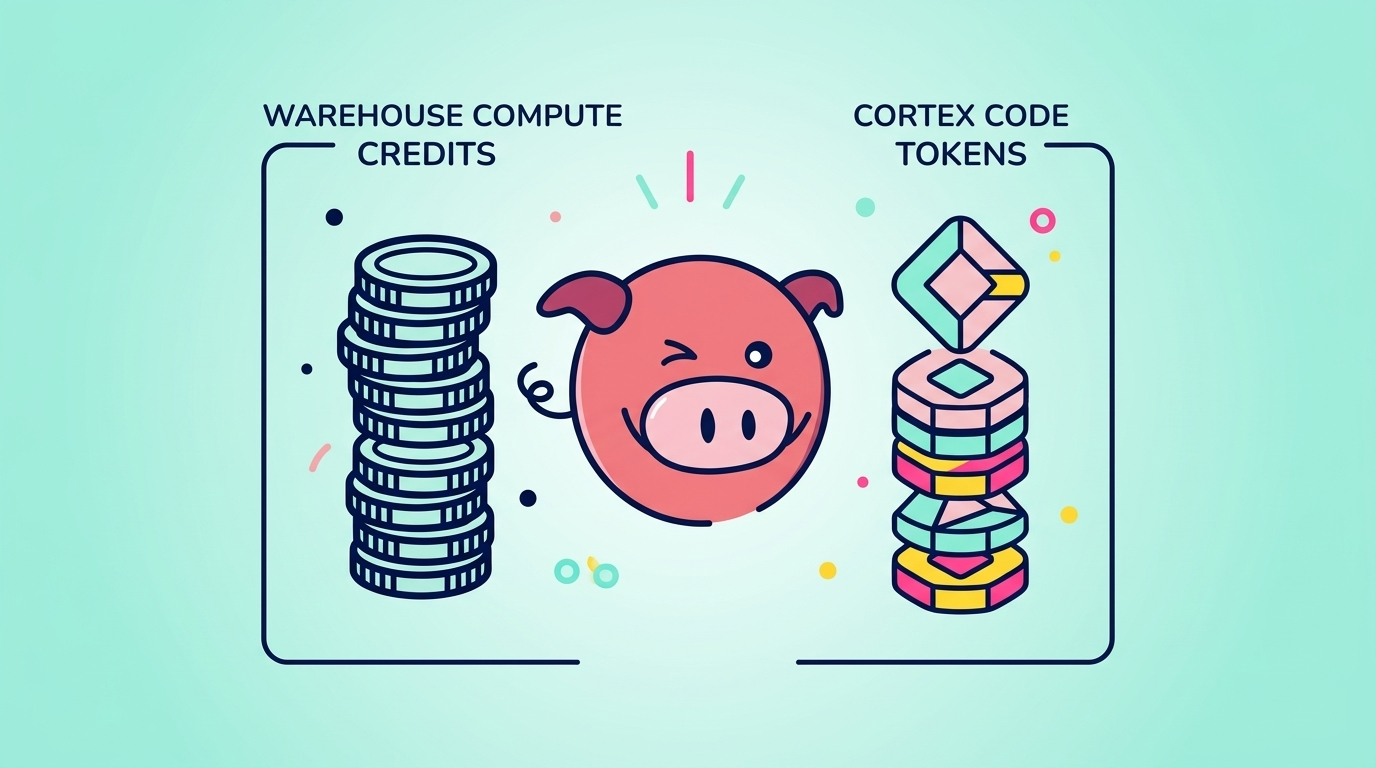
A team can be constantly optimizing in the sense of continuously tuning warehouses, and still be spending more each quarter because the growth is happening somewhere they are not looking. Warehouse compute is the part everyone watches. Serverless features, cloud services, storage, data transfer and AI features, most of them billed per token, are the part that grows quietly.
The useful internal question is not whether spend went up. It is whether the increase bought anything.
AI workloads arrive from outside the data team
This is the signal with the sharpest cost consequence. Snowflake’s CEO told analysts in May 2026 that if a customer rolls an AI agent out to 10,000 users, “cost governance is absolutely an issue.”
AI and LLM workloads can originate in marketing, product or operations rather than in the data team. Discussing its AI-driven growth in September 2026, Snowflake’s CFO said that CFOs, CROs, CMOs and CEOs now make the purchase decision. They get built quickly, they run against the warehouse, and they land on a bill you own but did not commission.
That breaks the normal feedback loop. The person who can see the cost cannot judge whether the workload is worth it, and the person who knows whether it is worth it never sees the cost. Without attribution back to the workload and its owner, an AI program can run for a quarter before anyone asks what it returned.
What to do with all this
Three things, none of which require waiting for the next earnings call.
Treat every new Snowflake feature as an evaluation, not an upgrade. Ask what it costs, at what volume it pays for itself, and how you would tell if it were not working. Features adopted because they are new are the ones that quietly cost money.
Measure spend outside warehouse compute separately. If your cost reporting collapses everything into one number, growth in serverless features, storage and AI is invisible until it is large. Snowflake’s METERING_DAILY_HISTORY view already splits credits by service type, so the breakdown is there to report on.
Attribute AI workloads to their owners from the first day. Snowflake now provides the controls, from per-user AI quotas that can block requests at a limit to budgets that track AI spend by team, but the team view only exists once someone tags each user to an owner. Retrofitting attribution after a quarter of spend is harder than tagging it at the start, and the conversation about value is much easier when you can name who asked for the workload.
Snowflake’s pace shows no sign of slowing down. The teams that stay in control of their bill are the ones who treat each release as a decision rather than an update.