TL;DR
Snowflake cost management in 2026 is about controlling compute spend while maintaining performance and reliability. Native Snowflake tools provide baseline visibility, but most organizations require third-party platforms for automation, deeper optimization, and clearer ROI. The best tools combine cost optimization, observability, and actionable intelligence across the entire data stack. Snowflake has become the standard cloud data warehouse for modern analytics. Its usage-based pricing model gives teams flexibility, but it also makes costs harder to predict and control as workloads scale.
When Data team want to fully understand their snowflake spend they need to refer to several aspects: their compute, their snowflake storage, their snowflake services and pipeline waste (pipeline that has a cost but not usage) – it is critical to find a tool that provide this holistic solution and not cover only part of it as you want to optimize your overall snowflake data cost and not only past of it
Today, Snowflake cost management tools fall into several categories: native Snowflake features, third-party cost observability tools, optimization-focused platforms, and solutions that combine both optimization and observability. This guide explores the best Snowflake cost management tools for 2026, from native solutions to specialized third-party platforms that help you optimize, observe, and control your data warehouse spending.
Table of Contents
- The Snowflake Cost Challenge in 2026
- Advanced Ways to Optimize Snowflake Costs
- What does Snowflake Native Cost Management Tool do
- Third-Party Snowflake Cost Management Solutions
- Comparison Table: Snowflake Cost Optimization Capabilities (2026)
- How to Choose the Right Snowflake Optimization Tool
The Snowflake Cost Challenge in 2026
By 2026, managing Snowflake costs is no longer just about warehouses and queries. Teams face a growing set of system-level challenges:
- Dynamic workloads with constantly changing query patterns and concurrency
- Warehouse configurations that drift over time, creating hidden waste
- Limited visibility into end-to-end cost drivers across pipelines and BI consumption – usage driven waste reduction
- Difficulty attributing spend to teams, data products, and business outcomes
- Inefficiencies embedded in pipelines and refresh schedules that compound quietly
- Snowflake AI services (Cortex, search, ML features) that behave like black boxes, introducing unpredictable and hard-to-attribute costs
- Understand and optimize your ETL cost
Addressing these challenges requires more than monitoring. It demands continuous analysis and automation across the entire data lifecycle.
Advanced ways to Optimize Snowflake Costs
Most Snowflake cost reductions come from applying several optimization levers together, not from a single fix.
Core optimization levers
- Right-size warehouses
Many workloads run on oversized compute sized for rare peak usage. Matching warehouse size to actual demand reduces waste immediately. - Reduce idle compute
Warehouses often continue running between queries, even with auto-suspend enabled. These small idle periods add up quickly. - Improve query and data model efficiency
Inefficient SQL, frequent dbt rebuilds, and unnecessary full-table scans are common drivers of high credit consumption. - Isolate workloads
Mixing BI dashboards, ad hoc analysis, and transformation jobs on the same warehouse leads to unpredictable cost spikes and performance issues. - Control user and BI behavior
Scheduled dashboards, over-refreshing reports, and unused analytics assets often become hidden cost drivers over time. - Clean up access and data
Removing inactive users and unused tables reduces unnecessary queries and background activity. - Identify anomalies and wrestling them
Code changes or workload behavior may create cost and performance anomalies, it is critical to find them as their happen and provent them from being tomorrow “standards”. - Paying for the right services that generate ROI
When should I use services line clustering columns, query acceleration, search optimization etc. are they optimally configured to provide best performance / cost balance?
Advanced optimization in 2026
As Snowflake environments grow more complex, advanced optimization techniques become essential.
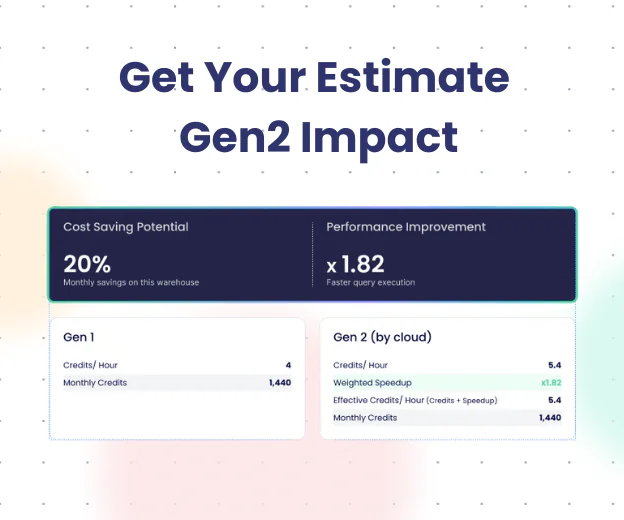
- Know when to transition to Gen2 warehouses
Understanding workload patterns helps teams decide if and when Gen2 warehouses will deliver better price-to-performance, automatically and hourly. - Idle time intelligence
Continuous monitoring at 1–5 second intervals allows warehouses to suspend immediately when queries stop, eliminating wasted minutes that native auto-suspend misses. - AI-powered auto clustering
Determines whether clustering is needed at all and recommends the best clustering keys based on real query behavior, not static assumptions. - Cortex AI monitoring
Uses Snowflake Cortex metadata and signals to understand workload behavior, usage trends, and optimization opportunities at scale. - AI-driven root cause analysis
Goes beyond detecting cost spikes to explain why they happened, helping teams prevent budget overruns instead of reacting after the fact.
Organizations typically unlock 30–40% Snowflake cost reduction only when these optimizations run continuously, rather than through manual, periodic reviews.
For more advanced warehouse optimization>>
What does Snowflake Native Cost Management Tool do?
Cost Management Interface (Snowsight)
Snowflake’s Cost Management Interface in Snowsight provides built-in visibility and control capabilities. Released to general availability in 2024, this centralized console offers:
Key features include:
- Organization overview: Visibility into spend across multiple accounts, contract consumption, and high-level forecasting
- Account overview: Monitoring of account-level costs with breakdowns by warehouses, queries, databases, and services
- Cost insights: System-generated suggestions pointing to potential areas of inefficiency
- Access controls: Available to users with budget_admin, budget_viewer, or ACCOUNTADMIN roles, expanding visibility beyond platform owners
Budgets
Budgets, generally available since 2024, let organizations define spending thresholds and receive alerts as usage approaches limits.
Capabilities:
- Account-level budgets monitoring all compute resources
- Custom budgets for specific resource groups (warehouses, serverless features)
- Email notifications with detailed alerts
- Integration with Cost Management Interface
Best for: Proactive spend control and preventing budget overruns before they happen.
Resource Monitors
Resource Monitors are built-in tools for tracking and controlling compute credit consumption at the account or warehouse level.
Actions Supported:
- Notify: Send alerts when credit thresholds are reached
- Notify & Suspend: Alert and suspend warehouses after current queries complete
- Notify & Suspend Immediately: Immediate suspension of all warehouse activity
Limitation: Reactive rather than proactive—Resource Monitors alert you to problems but don’t optimize or prevent inefficiencies.
Snowflake Trail for Observability
Snowflake Trail supports monitoring and troubleshooting across applications, pipelines, and compute resources. Teams use it to inspect performance behavior and diagnose operational issues. Trail focuses on observability and debugging rather than cost control or spend reduction.
Verdict on Native Tools:
Snowflake’s native cost management features provide essential visibility, alerting, and guardrails. They answer what was spent and when limits were crossed.
They do not deliver autonomous optimization, deep root-cause analysis, or automated remediation. As Snowflake environments grow more complex and AI-driven workloads expand, organizations increasingly rely on third-party platforms to move from cost awareness to continuous cost prevention.
Third-Party Snowflake Cost Management Solutions
1. Seemore Data: The Complete Platform for Observability, Efficiency & Cost Optimization
What Seemore Data Does:
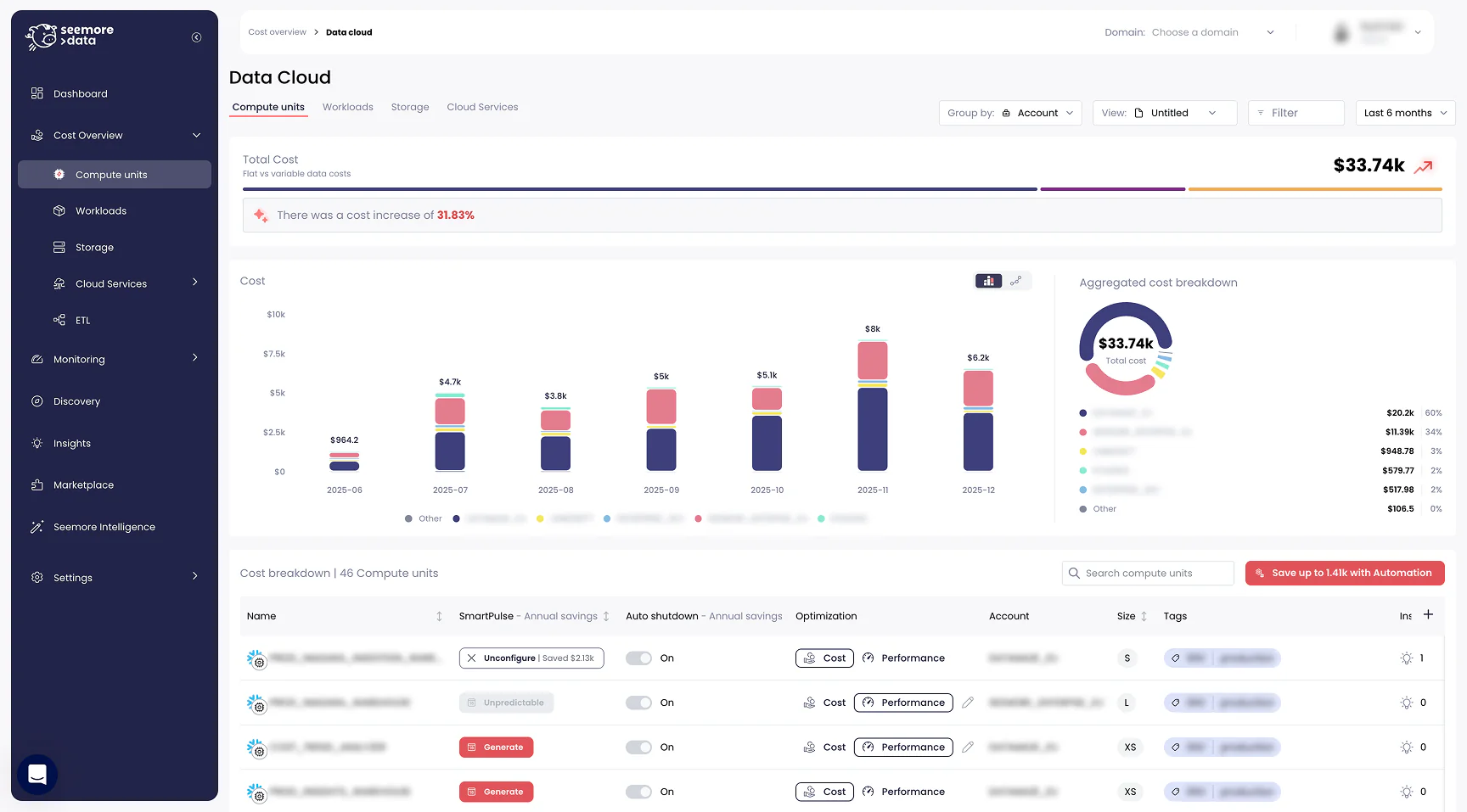
Seemore Data is a data efficiency platform built to manage Snowflake cost, performance, and usage as one connected system. Instead of treating cost control, observability, and optimization as separate problems, Seemore unifies them through an autonomous, context-aware data engineer agent.
The platform continuously analyzes how data is ingested, transformed, queried, and consumed, then adjusts infrastructure and workflows to reduce waste and protect performance. For data teams, Seemore functions as an always-on engineer that understands the full data lifecycle and acts with context rather than rules alone.
Core Capabilities:
Cost Control & Optimization:
- Real-time cost visibility with granular attribution by warehouse, user, domain, job, and data product
- Continuous detection of inefficiencies and waste as they appear
- Domain-specific budget management with enforcement and forecasting
- Proactive cost spike detection before they drain budgets
Autonomous Warehouse Optimization:
- Continuous autonomous warehouse management
- Dynamically resizes warehouses hourly and transitions workloads to Gen2 based on real usage patterns. Learn about Smart Pulse.
- Adaptive scaling and auto-suspend tuning to reduce idle spend beyond Snowflake default settings.
- Ongoing waste prevention through workload pattern analysis
Usage-Based Data Pipeline Optimization:
- End-to-end visibility into pipeline performance and cost
- Identification and elimination of overused or underused resources
- Alignment of compute and refresh behavior with actual demand
- Improvements to workflow efficiency across ingestion and transformation
Deep Observability & Lineage:
- Column-level lineage across Snowflake, pipelines, and BI tools
- Full asset discovery enriched with cost, frequency, and runtime metrics
- AI-assisted lineage navigation for fast impact analysis
- Root-cause analysis completed in minutes instead of days
Proactive AI Agent:
- Continuous anomaly detection across cost, usage, and performance
- Automated root-cause investigation with clear explanations
- Actionable recommendations with guided remediation steps
- Slack-based alerts and insights for real-time response
- AI-driven clustering recommendations based on actual query patterns
Deep BI Integration:
- Native and seamless integration with BI tools and analytics platforms
- Cost and performance tied directly to dashboards, reports, and business usage
- Clear ownership and accountability across data producers and consumers
Strengths:
- Transparent pricing and operations – no black box algorithms
- Proactive and predictive – catches issues before they become expensive
- Automated remediation – not just alerts, but actionable solutions
- Comprehensive coverage – cost, efficiency, and observability in one platform
- Fast onboarding – connect in minutes without code changes
- Column-level lineage superior to competitors
- Proven ROI – customers report 40-50% cost reductions
Where Seemore Stands Out:
While competitors often specialize in either cost management (or compute cost in some cases) OR observability OR performance, Seemore Data is the only platform that excels across all three dimensions simultaneously. It goes beyond monitoring to provide autonomous optimization, deep pipeline insights, and actionable AI-driven recommendations—all while maintaining full transparency into how optimizations work. Seemore Data was built as enterprise grand solution, providing all security, permissions and governance enterprise organizations needs.
Ideal For: Data-intensive organizations requiring holistic visibility, proactive cost control, and performance optimization across the entire data lifecycle.
Seemore Data vs. Snowflake Native Cost Management Tools
| Category | Seemore Data | Snowflake Native Tools |
| Core Goal |  Continuous optimization Continuous optimization |
 Visibility & guardrails Visibility & guardrails |
| Primary Benefit | Lower cost without hurting performance |
Spend awareness |
| Scope | End-to-end data stack
(Snowflake, ETL, dbt, BI) |
 Snowflake only Snowflake only |
| Cost Visibility | Granular, end-to-end |
Warehouse & query only |
| Business Context | Cost tied to ownership & usage |
Technical objects only |
| Budgets | Forecasting & anomaly-based |
Static thresholds |
| Cost Spike Detection | Early, behavior-based |
After limits crossed |
| Root Cause Analysis | Automated with lineage |
Manual |
| Warehouse Optimization | Autonomous & continuous |
Manual |
| Idle Compute Control | Active shutdown |
Fixed auto-suspend |
| Query Optimization | Context-aware |
Visibility only |
| Pipeline Visibility | Full |
None |
| Data Lineage | Column-level |
None |
| BI & Usage Awareness | Linked to dashboards & users |
None |
| Automation | Governed automation |
None |
| Operational Effort | Minimal |
Ongoing manual |
| Typical Outcome | 40–50% sustained savings |
Alerts & reports |
Efficiency-Focused tools
These tools primarily concentrate on improving query efficiency or warehouse usage within Snowflake. They can deliver meaningful savings in targeted areas but typically operate without full end-to-end context across pipelines, lineage, and business usage.
2. Select.dev
Focus: Snowflake warehouse and query efficiency with strong cost visibility
Strengths:
- Practical guidance for warehouse sizing and configuration
- Query performance analysis with optimization recommendations
- Visibility into Snowflake compute usage across workloads
- Native dbt integration supporting analytics engineering workflows
Weaknesses:
- Limited end-to-end lineage compared to observability-first platforms
- Optimization remains largely manual rather than autonomous
- Minimal proactive anomaly detection or root-cause explanation
- Focuses on Snowflake in isolation without full pipeline or BI context
Best suited for: Teams looking to improve Snowflake efficiency through hands-on tuning and education.
Focus: AI-assisted SQL optimization and dbt development acceleration
3. Altimate AI
Strengths:
- Automated SQL optimization suggestions
- Tight integration with dbt Power User for development workflows
- Helpful performance insights for individual Snowflake queries
Limitations:
- Narrow scope centered on query-level tuning
- Limited warehouse-level optimization and scheduling capabilities
- Minimal cost governance, anomaly detection, or lineage depth
Best suited for: Analytics engineering teams focused on improving dbt models and SQL performance.
4. Slingshot (Capital One)
Focus: Warehouse scheduling and compute efficiency
Strengths:
- Scheduling-based warehouse optimization
- Emphasis on balancing cost and performance
- Enterprise-grade tooling developed by Capital One
Limitations:
- Primarily focused on scheduling rather than continuous optimization
- Limited autonomous decision-making beyond predefined rules
- Lacks deep observability, lineage, and business usage context
Best suited for: Large enterprises seeking structured warehouse scheduling controls.
Snowflake Compute Cost-Focused Tools
5. Espresso.ai
Focus: ML-driven Snowflake cost optimization
Strengths:
- Automated warehouse autoscaling and intelligent scheduling
- Query rewriting aimed at improving runtime efficiency
- Aggressive cost-reduction positioning with rapid initial savings claims
Limitations:
- Narrow focus on cost reduction without deep observability or usage context
- Limited pipeline, lineage, and BI visibility
- Less comprehensive warehouse governance controls
- Newer entrant with limited long-term enterprise validation
Best suited for: Teams seeking quick, tactical cost reductions with minimal setup.
6. Keebo
Focus: Autonomous cost optimization for Snowflake and Databricks
Strengths:
- Continuous warehouse tuning through automated optimization
- Query routing to distribute workloads more efficiently
- Always-on optimization requiring minimal manual intervention
Limitations:
- Cost-first design with limited observability depth
- Minimal end-to-end data lineage or business context
- Optimization primarily centered on warehouse behavior
Best suited for: Organizations prioritizing automated compute efficiency over system-wide insight.
Comparison Table of Snowflake Optimization Capabilities (2026)
| Feature / Benefit | Seemore Data | Efficiency-Focused Tools | Cost-Focused Tools |
| Primary Goal | End-to-end cost, performance, and usage optimization | Improve query and warehouse efficiency | Reduce Snowflake spend quickly |
| End-to-End Stack Coverage | Full stack (ETL → Snowflake → BI) |
Mostly Snowflake |
Snowflake-centric |
| Cost Visibility | Granular & real-time |
Query / warehouse-level |
Strong cost focus |
| Automation Level | High, governed |
Medium |
Medium |
| Cost Attribution (Teams, Domains, Products) | Granular |
Partial |
Partial |
| Business Usage Context (BI, Consumers) | Yes |
No |
No |
| Data Lineage Depth | Column-level, cost-aware |
Limited |
Minimal |
| Warehouse Optimization | Autonomous and continuous |
Manual or rule-based |
Automated but cost-only |
| Pipeline Optimization | End-to-end, usage-based |
Query-level |
Not a focus |
| Idle Compute Prevention | Active shutdown |
Partial |
Partial |
| Query Optimization | Context-aware with impact analysis |
Core strength |
Core strength |
| Anomaly Detection | Proactive, behavioral |
Limited |
Threshold-based |
| Root Cause Analysis | Automated with lineage and usage |
Manual |
Cost-focused |
| Operational Effort Required | Low |
Medium–High |
Low–Medium |
| Typical Outcome | Sustained savings with performance protection | Incremental efficiency gains | Fast but narrow cost reduction |
How to Choose the Right Snowflake Cost Optimization Tool For You?
The right Snowflake cost tool depends on what problem you are trying to solve today and how much manual effort your team can sustain long term.
- Need better visibility into queries and warehouses?
Efficiency-focused tools such as Select.dev, Altimate, and Slingshot help teams analyze query behavior, tune warehouses, and improve dbt-driven workflows. Optimization typically remains limited and engineer-led. - Looking for targeted compute focus cost reduction?
Cost-first tools including Espresso.ai and Keebo concentrate on warehouse and query optimization to reduce compute spend, usually with limited pipeline or business context. - Need ongoing cost control with full context across the data lifecycle?
Seemore Data combines end-to-end visibility with advanced, automated optimization across Snowflake warehouse, storage, services, pipelines, and BI. It continuously right-sizes warehouses, eliminates idle compute, optimizes pipelines and workloads, and explains cost spikes through deep lineage and root-cause analysis.
By automating decisions that traditionally require constant manual tuning, Seemore helps teams manage Snowflake cost as a connected system rather than isolated resources.
Book a demo to bring your Snowflake optimization strategy into 2026.