Why Multiple Players Will Own the Data Cost Intelligence Market
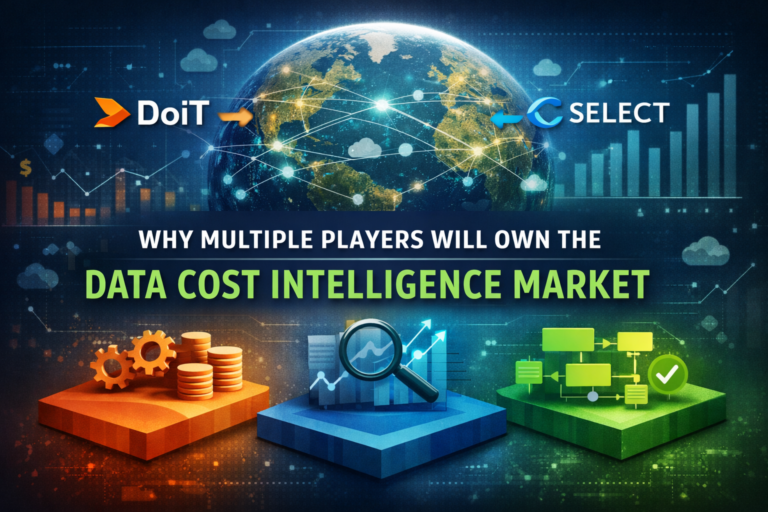
DoiT Acquires SELECT – The recent acquisition isn’t just another industry headline. It’s a signal – and an important one.
It means that the market has reached a point where cost intelligence in data platforms is no longer optional.
This move validates the category. It doesn’t close it.
From “cost awareness” to cost intelligence
For years, data teams operated under a familiar assumption: scale first, optimize later. Snowflake and modern cloud data platforms made it easy to move fast – but much harder to understand what that speed actually costs.
We’re now seeing a clear shift: From reactive cost reports To proactive, decision-time cost intelligence.
Organizations don’t just want to know what they spent.
They want to know:
- What is driving that spend
- What is safe to change
- And what will break – or save money – before they touch anything
That’s the context in which acquisitions like this make sense.
Validation, not consolidation
DoiT acquiring SELECT doesn’t mean the market is consolidating into a single player. It means the problem is big, persistent, and valuable enough to justify long-term investment.
In practice, this space is fragmenting – not shrinking.
Why? Because buyers are not all the same.
Different buyers, different optimization needs
There is no single “cost optimization user” inside an enterprise:
- FinOps and cloud teams focus on governance, budgets, and accountability
- Data engineering leaders care about confidence: Can we optimize without breaking production?
- Platform teams need system-level understanding of how data usage, lineage, and cost interact
These needs don’t collapse neatly into one tool or one workflow.
As a result, enterprises increasingly operate multiple optimization layers – each answering a different question:
- Where is money going?
- Why is it happening?
- And what can we safely do about it?
FinOps platforms vs. data engineering–first intelligence
This is where the market is clearly diverging.
Some solutions start from cloud spend and work inward.
Others start from data behavior and work outward.
Both approaches have value – but they solve different problems.
A spend-first approach excels at reporting and financial visibility.
A data-first approach focuses on prevention: understanding usage patterns, blast radius, and downstream impact before costs escalate.
As data stacks grow more complex, that distinction matters more – not less.
Where Seemore Data fits in this landscape
Seemore Data is intentionally focused on one thing: making data teams successful.
Not as a cloud reseller.
Not as a billing abstraction layer.
But as a system that connects data usage, lineage, impact, and cost into a single, actionable view.
That focus allows teams to:
- Optimize with confidence
- Act earlier, not after the bill arrives
- And treat cost as a design constraint – not a postmortem metric
As the industry moves toward proactive cost intelligence, context becomes the differentiator.
The bigger picture
This acquisition is good news – for customers and for the market.
It confirms what many teams already feel:
Data cost optimization is now core infrastructure, not a nice-to-have.
And like any mature infrastructure layer, it won’t be owned by one player alone.
The future belongs to ecosystems – not silver bullets.